|
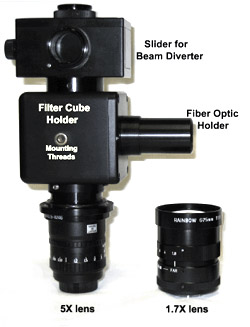
In actual use we anticipate that the MacroScope-IIa would be attached directly to the
camera or optical coupler via the vertical C-mount port. A beamsplitter and secondary port is provided if a
higher spatial resolution image of the object is needed; obtaining a
high resolution image would be most useful for measurements made with
the low resolution PDA cameras. For the high resolution camera we use
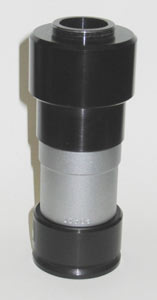
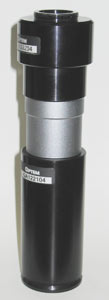
a Dage MTI CCD-300E-RC. The optical coupler
is an OPTEM RL081099.
A Camera Carrier could be used for rough focus
adjustment. We have mounted the preparation on an X-Y stage
(#XY6060M20, Danaher Motion,7C Raymond Avenue,Salem, NH 03079, (800)-227-1066) which is
in turn mounted on a Z-axis focusing device, 488 series Compact
Laboratory Jack with Rotary Platform, (Newport Corp., Irvine, CA
92606, (800) 222-6440) which provides a convenient method for fine
focus.
In our laboratory the lamphouse-condenser-heat-filter-interference-filter
subsystem is mounted independently on a Newport model 281 Laboratory
Jack to facilitate vertical adjustment. However, if the lamp and Macroscope are coupled via a light guide, then
the vertical adjustment problem is obviated. While the use of a light
guide for illumination is convenient, David Kleinfeld
(personal communication) said that in the best of circumstances there
is a 40% loss of intensity in comparison with direct illumination
using the lamp condenser lens. When using direct illumination the
Fiber Optic Holder on the Macroscope can be
removed. In addition we mount the shutter independently on a separate
table to avoid interference from its vibrations.
The user specifies the wavelengths for the incident
light filter, dichroic mirror and secondary filter for a filter cube,
U-M509 (U-MF/XL) purchased from Olympus which is then populated by
filters from Chroma Technology, Rockingham, VT 05302, (802) 428-2500. Additional filter cubes can be
obtained from Olympus-Chroma. If oblique illumination is used the
dichroic mirror can be removed.
|