Main Features
·
Simultaneous optical and electrical (8 channels) recording
· Software control of a shutter and a stimulator
· 3 available modes for triggering of acquisition/averaging:
· Analogue output for voltage commands
 |
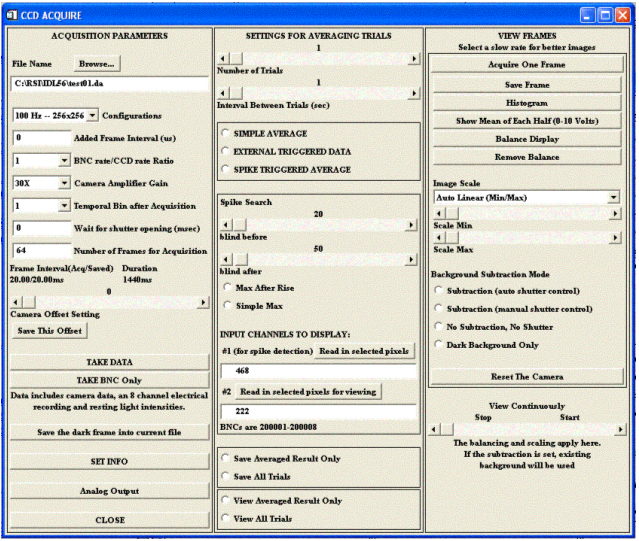
Acquisition has its own interface,
available from the primary Analysis interface. CardioPlex software also
controls various aspects of the experiment, such as the shutter and the
stimulator.
The data
acquisition software is specific to particular PC-based image grabber
and analogue-to-digital converter cards. The CardioCCD-SMQ interface is
shown at left, Enlarge. |
Some
capabilities of the acquisition section are:

Signal
Averaging:
Three
types of averaging are available.
1.
Averaging from a trigger provided by the computer.
2.
Averaging from the occurrence of a spike on one of the recorded
channels.
3.
Averaging from the occurrence of an external event such as the EKG.
Subset(s)/Binning:
For the
CardioPDA-III photodiode array system, a subset of the diodes can be
selected for acquisition. Using a subset allows an increase in the
frame rate above 1.6 kHz and/or a reduction in the size of the
resulting data file. For CardioCCD-SMQ, 2x2 or 3x3 binning can be used
to increase the frame rate, reduce the data storage requirements,
and/or reduce the relative dark-noise contribution.
Other
Features and Parameter
| ·
|
The
cameras may be run continuously prior to recording for focusing and
other set-up purposes. |
| ·
|
Information
pertaining to each trial may be captured in a file and augmented with
auxiliary comments. |
| ·
|
Analog
output may be created or read from an external file and applied to
control membrane potential. |
Other parameters
under the user's control include:
1.
a directory and file name (with numerical suffix incremented
automatically)
2.
the number of frames to be recorded, the frame interval,
3.
temporal binning of 2, 4, or 8, frames
4.
the number of trials (for averaging)
5.
the interval between trials (for averaging)
6.
the interval between opening the shutter and the start of recording.
|